Scalable Physical Integration with ageNtic Expertise

SPINE: Bridging the Cyber‑Physical Gap with Agentic AI

Minkyu Ham1,*, Dongho Kim1,*, Chan Lee1,*, Min Jun Kim1, Yixi Zhang2, Jiayi Wang2, Han Liu1,2,†

1Department of Statistics and Data Science, Northwestern University   2Department of Computer Science, Northwestern University
*Equal contribution, alphabetical by last name   Correspondence: hanliu@northwestern.edu

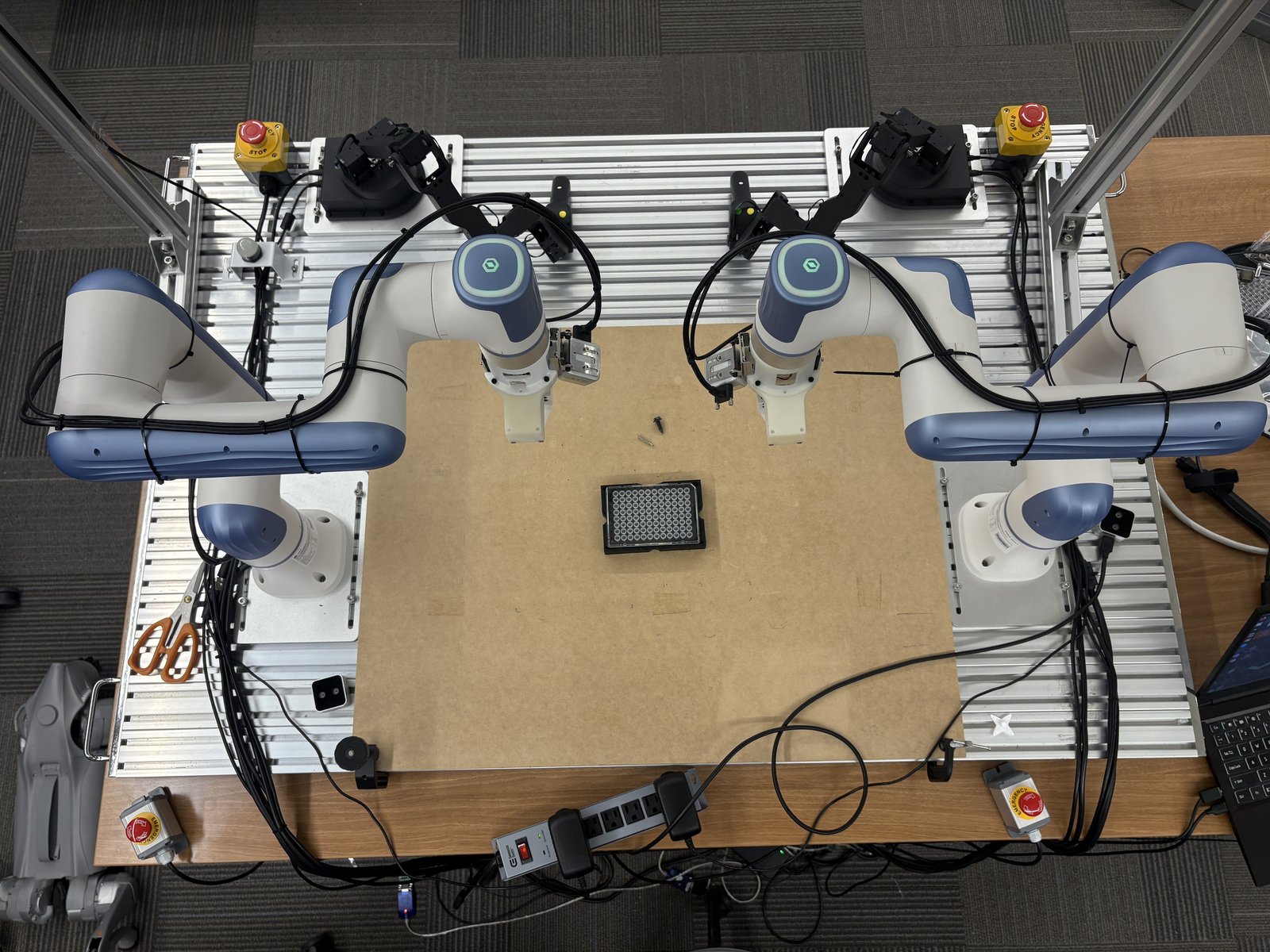
DOBOT X-Trainer bimanual teleoperation platform seen from above
DOBOT X-Trainer. Two follower arms, two leader arms, RealSense cameras and a vendor SDK over static Ethernet. Seven scenarios.
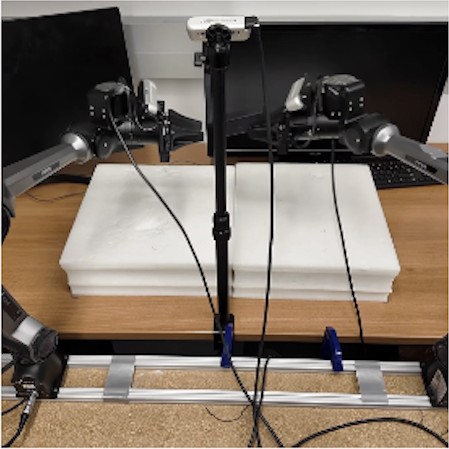
AgileX PiPER bimanual platform
AgileX PiPER. Four PiPER 6-DOF arms on ROS Noetic with USB-to-CAN adapters and RealSense cameras. Five scenarios.

Abstract

Foundation models give robots powerful high-level reasoning, yet turning that intelligence into reliable physical action remains difficult: roboticists must still align device drivers, network interfaces, sensors, controllers, and safety constraints for each platform. This often-overlooked integration layer acts as the robot's spinal cord, translating high-level intent into coordinated physical behavior, and remains a primary bottleneck for scalable Embodied AI. Hence, we propose SPINE (Scalable Physical Integration with ageNtic Expertise), an agentic framework for systematically debugging and deploying bimanual robots for teleoperation. SPINE centers on two subagent-driven workflows: a profile builder that compiles robot-specific context and a debugger that uses that context to iterate through diagnosis, repair, and validation until teleoperation succeeds.

Across two bimanual robots and 12 debugging scenarios, novice-operated SPINE debugged more accurately and efficiently than expert operators using vanilla LLMs. On DOBOT X-Trainer, SPINE improved success from 76% to 100% and reduced mean time-to-teleoperation by 30%; on AgileX PiPER, SPINE also achieved 100% success and reduced mean time-to-teleoperation by 38%. Together, these results show that SPINE leverages agentic AI to solve a critical integration bottleneck, helping bridge the cyber-physical gap that limits scalable real-world embodied AI.
Overall outcomes. OSS is the fraction of implanted faults resolved per trial; TTO is time-to-teleoperation and includes unsuccessful trials. Human operators use Claude Code with the same language model but without SPINE.
PlatformConditionTrialsOSSMean TTO
DOBOT X-TrainerSPINE, novice operator3 × 71.0010:20
Human operators with Claude Code7 × 70.7614:51
AgileX PiPERSPINE, novice operator3 × 51.007:48
Human operators with Claude Code9 × 50.9912:30

Method

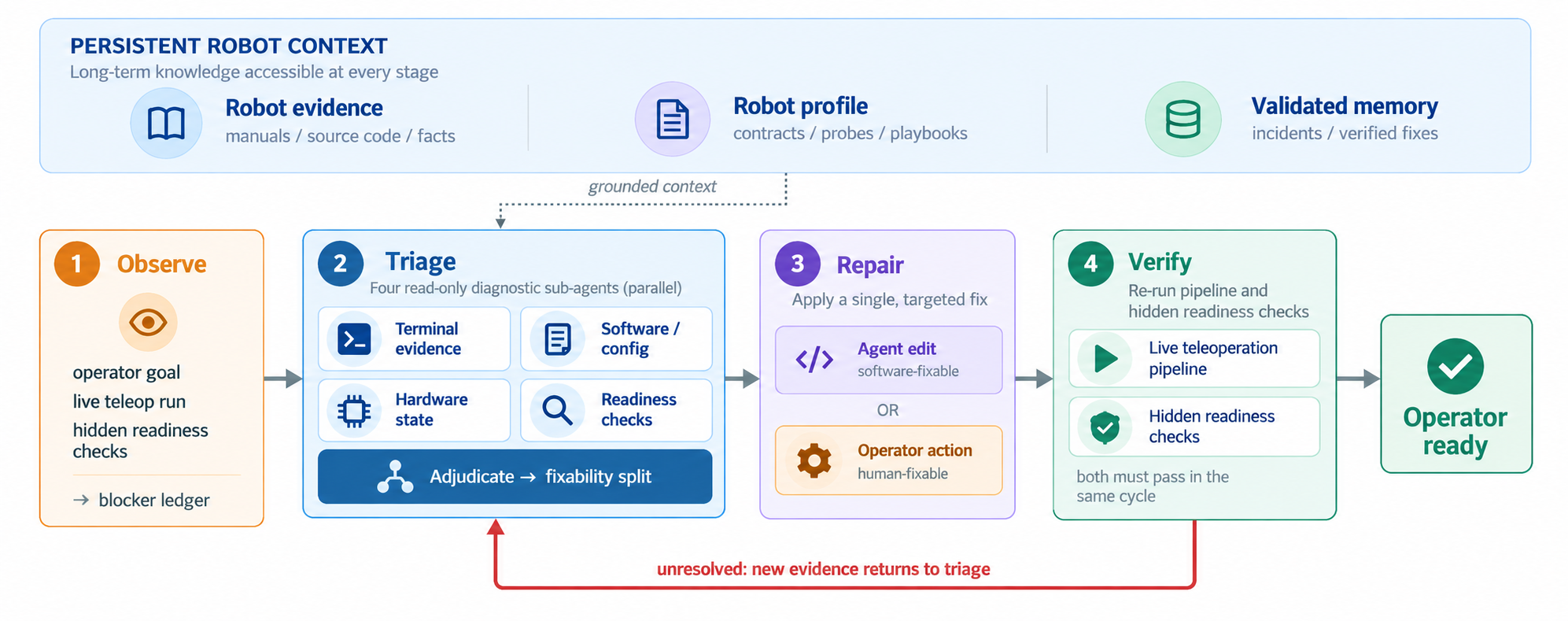
SPINE runs inside Claude Code as two skills. Profile building compiles documentation, a known-good repository and operator-confirmed facts into a sealed robot profile: eight category files plus a manifest, from which runtime adapters derive operating contracts, executable probes and readiness checks, hardware playbooks, and a command graph of the teleoperation pipeline. Nine extraction subagents draft it in parallel; curators, an adjudicator and a deterministic profile doctor check it before it is sealed.

Debugging is an observe–triage–repair–verify loop. Observation consolidates failures into a blocker ledger. Triage dispatches four read-only diagnostic subagents in one parallel call and adjudicates their reports into a fixability split. Repair applies either one software edit or one operator action from a component-specific playbook. Verification reruns the live teleoperation pipeline and hidden readiness checks together; a case closes only when both pass in the same cycle, and incident memory keeps only fixes backed by a passed validation record.

SPINE architecture: persistent robot context (robot evidence, robot profile, validated memory) grounds a four-stage loop of observe, triage, repair and verify; unresolved cases return new evidence to triage.
Figure 1. SPINE separates persistent robot knowledge from a goal-conditioned recovery loop. Triage dispatches four read-only diagnostic sub-agents in one parallel call and adjudicates their reports into a fixability split; repair is a separate stage that applies either a software edit or one operator action. Verification reruns the live teleoperation pipeline and hidden readiness checks together, and unresolved cases return to triage with new evidence rather than restarting observation.

Debugging scenarios

Twelve scenarios across software-only (SW), hardware-only (HW) and hybrid (HY) faults. Each contains two faults except D-HW1. An administrator implants them without revealing the scenario; success means the follower arms and grippers respond to the master arms while the required camera streams are available.

Results

Per-scenario outcomes. SPINE runs three trials per scenario; human trials pool seven operators on DOBOT and nine on PiPER. OSS is the fraction of implanted faults resolved in a trial; TTO is mean ± SD time-to-teleoperation, including unsuccessful trials.

DOBOT X-Trainer

Time-to-teleoperation

mm:ss, mean with SD, lower is better

Faults resolved (OSS)

mean fraction of implanted faults

SPINEHuman operators

AgileX PiPER

Time-to-teleoperation

mm:ss, mean with SD, lower is better

Faults resolved (OSS)

mean fraction of implanted faults

SPINEHuman operators

Ablation on DOBOT

Removing the robot profile or the hardware playbook lowers fault resolution and lengthens debugging, with the losses concentrated in hardware-only and hybrid scenarios. Each ablated variant has one trial per scenario, so these are preliminary.

Code

The framework is released as open source. The repository link will be added here on release.

BibTeX

@article{ham2026spine,
  title={SPINE: Bridging the Cyber-Physical Gap with Agentic AI},
  author={Ham, Minkyu and Kim, Dongho and Lee, Chan and Kim, Min Jun and Zhang, Yixi and Wang, Jiayi and Liu, Han},
  year={2026}
}